
PTECH+® FIELD INSPECTION – COMPLETE GUIDE
The TSC Drill Pipe engineering team developed the PTECH+® inspection procedures and drawings to provide a clear, uniform standard for assessing connection integrity, supporting safe operation, and dependable performance in the field.
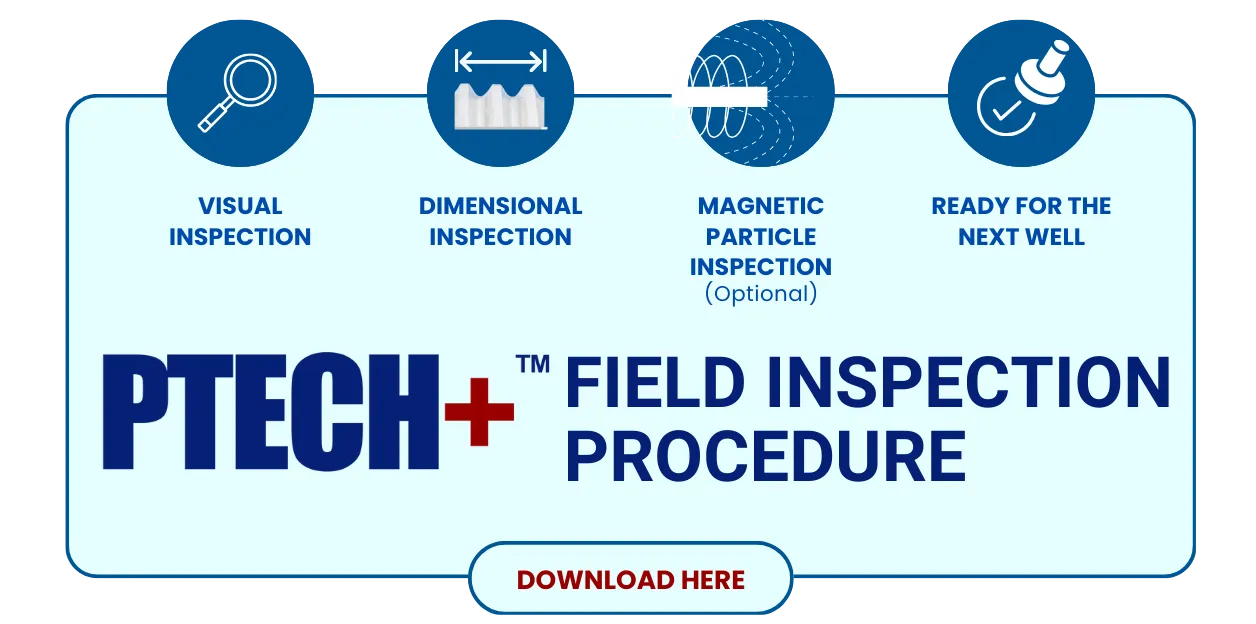
PTECH+® Pin and Box Field Inspection Drawings
FREQUENTLY ASKED QUESTIONS
What Non-Destructive Testing (NDT) methods are used in field inspections?
Field crews utilize Electromagnetic Inspection (EMI), Magnetic Particle Inspection (MPI), Liquid Penetrant Testing (PT), Ultrasonic Flaw Detection (UT), and full dimensional thread/shoulder gauging to evaluate structural condition.
How does Electromagnetic Inspection evaluate pipe body integrity?
Mobile EMI units pass electromagnetic fields through the pipe body to detect transverse fatigue cracks, wall thinning, localized pitting, and mechanical gouges, categorizing pipe joints into API wear classes based on remaining wall thickness.
Are on-site thread refacing services provided by field crews?
Yes. Field inspection teams carry portable refacing tools to dress minor shoulder scratches, burrs, and galling on location, restoring shoulder sealing faces without transporting pipe back to a repair shop.
What is the operational difference between DS-1 Category 3 and Category 5 inspections?
Category 3 applies to standard drilling environments with moderate stress risk. Category 5 represents the highest inspection severity tier, mandating full-length UT wall scanning and MPI thread root checks for ultra-deep, extended-reach, or HPHT wells.
Can mobile inspection units be deployed directly to remote rig sites?
Yes. Self-contained mobile inspection vehicles equipped with EMI units, NDT instrumentation, and certified crews deploy directly to land rig locations, offshore supply yards, or customer pipe storage facilities.